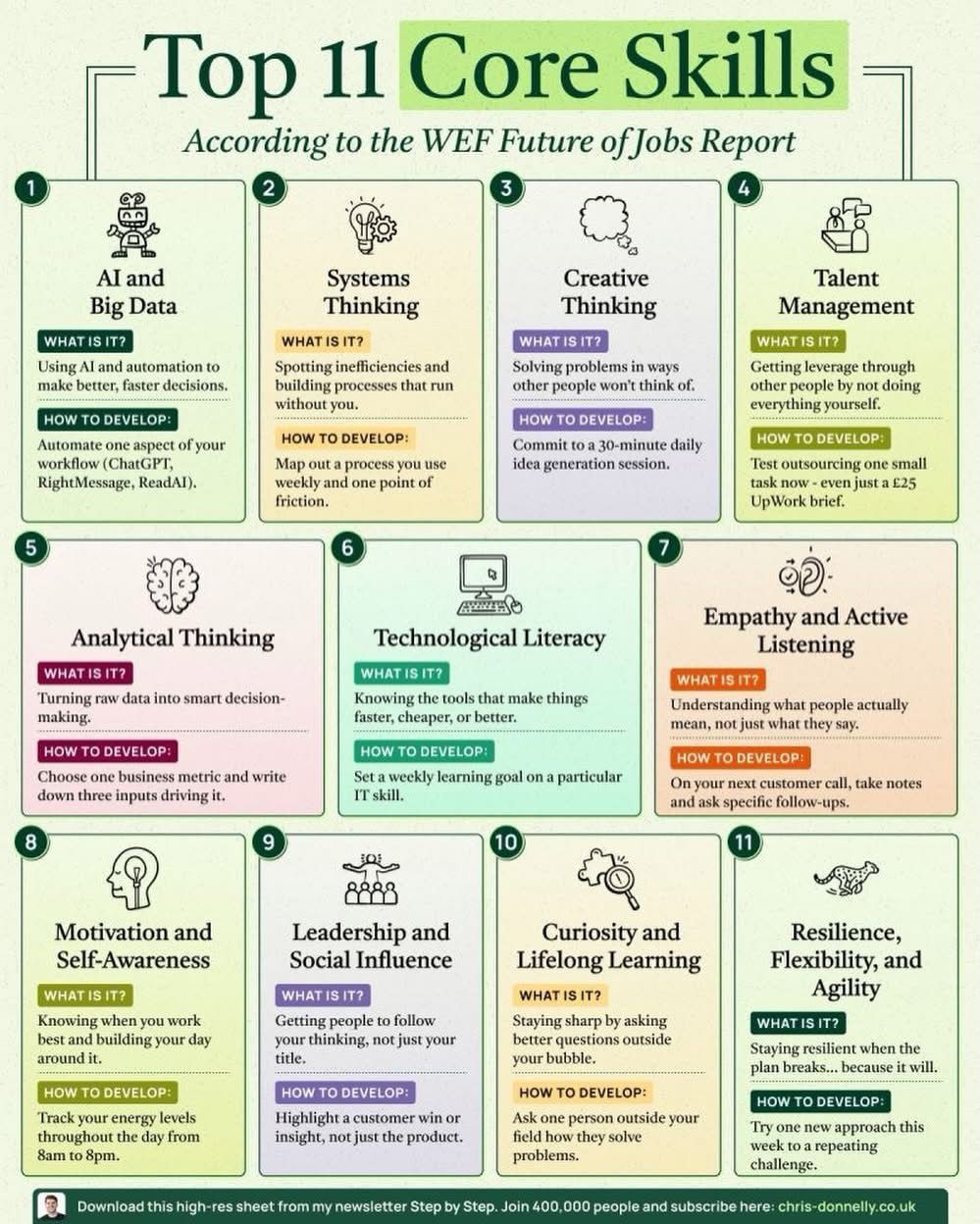
Below is the list exactly where the future of work and education is heading. I’ll elaborate on each skill in a deeper, more reflective way (beyond buzzwords), and connect them to real capability development, not just employability.
1. AI and Big Data
This is not about becoming a programmer—it’s about thinking with machines.
People who thrive will know how to ask the right questions of AI, interpret outputs critically, and understand bias, limits, and ethical implications of data-driven decisions.
Why it matters:
AI increasingly mediates decisions in hiring, healthcare, finance, education, and governance. Those who can work alongside AI—rather than fear or blindly trust it—will shape outcomes.
How to develop:
• Use AI tools as thinking partners, not shortcuts
• Learn basic data literacy: trends, correlations, causation
• Question outputs: What assumptions are embedded here?
2. Systems Thinking
Systems thinking is the ability to see connections, feedback loops, and unintended consequences rather than isolated events.
Why it matters:
Most real-world problems—climate change, education reform, public health, organizational failure—are systemic, not technical.
How to develop:
• Map processes end-to-end
• Ask “What happens next?” and “Who else is affected?”
• Study failures as system breakdowns, not individual mistakes
3. Creative Thinking
Creativity is not about art—it is about novel problem framing.
Why it matters:
Routine solutions can be automated. Original thinking cannot. Creativity allows people to reframe problems, combine ideas across domains, and imagine alternatives.
How to develop:
• Deliberately expose yourself to unfamiliar fields
• Practice idea generation without immediate judgment
• Ask “What if we did the opposite?”
4. Talent Management
This is the skill of unlocking potential in others, not controlling them.
Why it matters:
Organizations increasingly succeed through collaboration, not hierarchy. Leaders must coach, empower, and align strengths rather than micromanage.
How to develop:
• Learn to delegate meaningfully
• Give feedback that develops, not demoralizes
• Focus on strengths, not just weaknesses
5. Analytical Thinking
Analytical thinking is the discipline of reasoning clearly under uncertainty.
Why it matters:
In a world flooded with information, the real skill is deciding what matters and why.
How to develop:
• Break problems into assumptions
• Distinguish evidence from opinion
• Practice explaining complex ideas simply
6. Technological Literacy
This is not knowing every tool, but knowing how technology shapes behavior, power, and efficiency.
Why it matters:
Technology increasingly structures work, communication, surveillance, and decision-making.
How to develop:
• Learn why tools exist, not just how to use them
• Stay adaptable as platforms change
• Understand trade-offs (speed vs quality, convenience vs privacy)
7. Empathy and Active Listening
Empathy is intellectual humility—the ability to understand perspectives beyond your own.
Why it matters:
As automation grows, human-centered skills become more valuable. Empathy improves leadership, negotiation, teaching, and conflict resolution.
How to develop:
• Listen to understand, not to respond
• Ask clarifying questions
• Reflect back what you hear before reacting
8. Motivation and Self-Awareness
This is knowing how you function best—your energy, limits, values, and triggers.
Why it matters:
Sustainable performance requires self-regulation, not constant pressure.
How to develop:
• Track when you do your best thinking
• Reflect on failures without self-blame
• Align work with meaning, not just rewards
9. Leadership and Social Influence
Leadership is influence grounded in credibility and trust, not authority.
Why it matters:
Future leaders must guide through complexity, uncertainty, and diversity—not command-and-control.
How to develop:
• Lead through ideas and example
• Communicate vision clearly
• Build coalitions, not followers
10. Curiosity and Lifelong Learning
Curiosity is the engine of adaptability.
Why it matters:
Jobs change faster than degrees. The most valuable skill is the ability to learn, unlearn, and relearn.
How to develop:
• Ask better questions, not just seek answers
• Read outside your discipline
• Treat learning as a habit, not a phase
11. Resilience, Flexibility, and Agility
This is not just “being tough”—it’s recovering, adapting, and evolving.
Why it matters:
Careers are no longer linear. Setbacks, disruptions, and reinvention are normal.
How to develop:
• Reframe failure as feedback
• Practice small experiments
• Stay open to change without losing core values
Big Picture Insight
What’s striking about this list is that most of these are thinking skills, not technical skills. This aligns strongly with my earlier point about PhD training:
The future belongs to thinkers, not narrow specialists!