
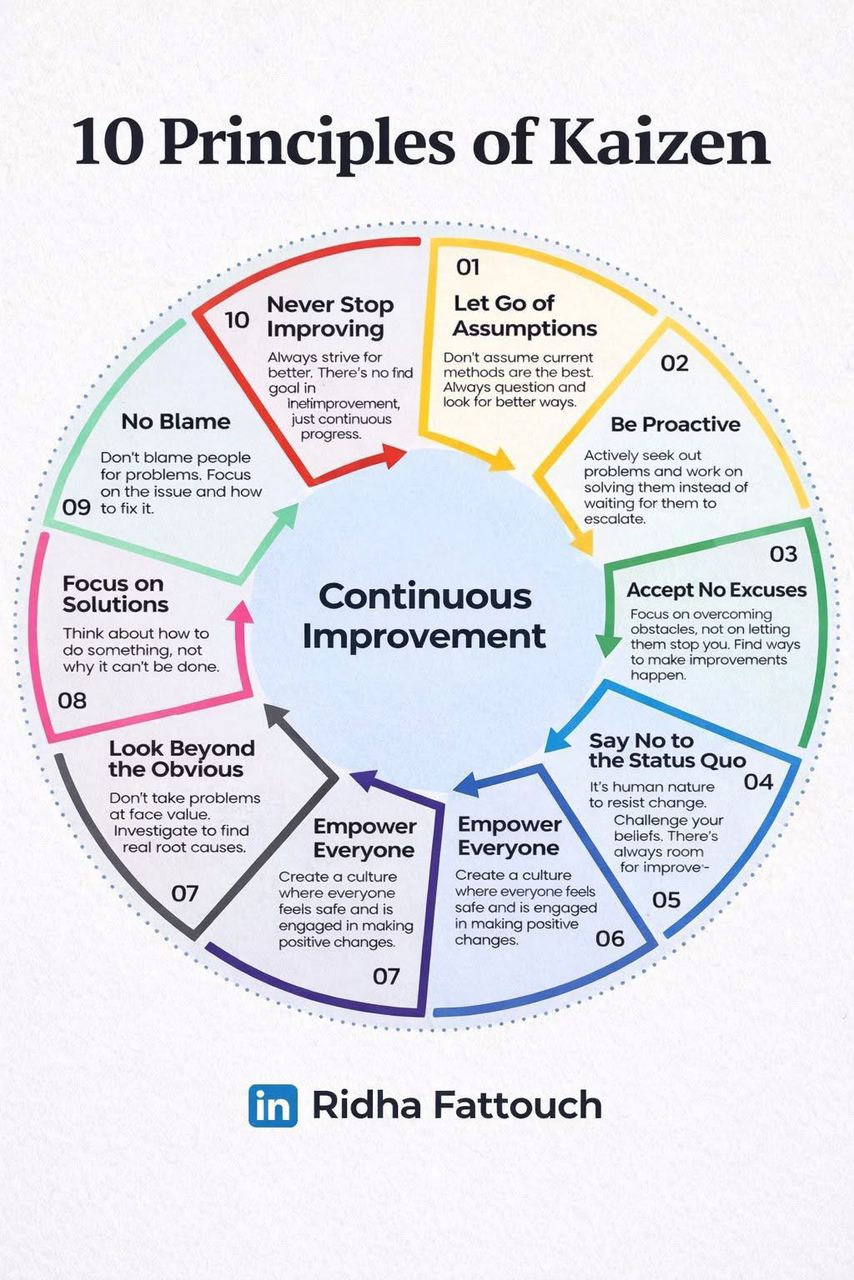
The 10 Principles of Kaizen highlight continuous improvement through small, consistent actions rather than radical change. Rooted in the Japanese idea of “change for better,” Kaizen encourages proactive thinking, accountability, collaboration, and a no-blame culture.
By focusing on solutions and daily incremental progress, Kaizen helps organizations enhance efficiency, improve quality, and build a sustainable high-performance culture.
The image presents “10 Principles of Kaizen” centered around the idea of Continuous Improvement. Kaizen, a Japanese philosophy meaning “change for better,” is not about radical transformation — it is about small, consistent improvements that accumulate into significant progress over time.
Below is a detailed elaboration of each principle and how it applies in professional and organizational contexts.
1️⃣ Let Go of Assumptions
“Don’t assume current methods are the best.”
Assumptions are invisible barriers to improvement. Many organizations operate on inherited routines: “This is how we’ve always done it.” Kaizen challenges this mindset.
• Question existing workflows regularly.
• Use data instead of opinions.
• Benchmark against best practices.
• Encourage constructive questioning from all levels.
Impact: Creates intellectual humility and openness to innovation.
2️⃣ Be Proactive
“Actively seek problems before they escalate.”
Kaizen sees problems as opportunities for improvement — not as threats.
• Identify bottlenecks early.
• Conduct routine audits and feedback sessions.
• Encourage reporting of small inefficiencies.
• Use preventive action instead of corrective reaction.
Impact: Reduces crisis management and builds organizational resilience.
3️⃣ Accept No Excuses
“Focus on overcoming obstacles.”
Excuses protect comfort zones. Kaizen promotes accountability.
• Shift from “Why it can’t be done” to “How it can be done.”
• Break big challenges into smaller achievable steps.
• Focus on controllable factors.
• Replace blame with responsibility.
Impact: Builds a results-driven and solution-oriented culture.
4️⃣ Say No to the Status Quo
“Challenge comfort and resist stagnation.”
Improvement requires discomfort. Growth happens outside routines.
• Regularly review processes for relevance.
• Set stretch targets.
• Encourage experimentation.
• Reward initiative and innovation.
Impact: Prevents organizational complacency.
5️⃣ Empower Everyone
“Improvement is everyone’s responsibility.”
Kaizen is not top-down; it is participatory.
• Create safe spaces for ideas.
• Flatten communication barriers.
• Encourage cross-functional collaboration.
• Recognize contributions publicly.
Impact: Builds ownership and engagement across the organization.
6️⃣ (Expanded from Empowerment Theme) Build a Culture of Engagement
True empowerment goes beyond permission — it requires capability.
• Provide training and skill development.
• Develop problem-solving competencies.
• Encourage peer mentoring.
• Align individual goals with institutional goals.
Impact: Turns employees from task executors into change agents.
7️⃣ Look Beyond the Obvious
“Find root causes, not surface symptoms.”
Many organizations solve symptoms rather than problems.
• Use tools like the 5 Whys.
• Conduct root cause analysis.
• Examine systems, not just individuals.
• Collect qualitative and quantitative evidence.
Impact: Produces sustainable solutions instead of temporary fixes.
8️⃣ Focus on Solutions
“Think about how to do something.”
Problem-focused thinking drains energy. Solution-focused thinking drives action.
• Limit time spent on complaints.
• Set solution deadlines.
• Encourage brainstorming sessions.
• Pilot test ideas quickly.
Impact: Accelerates improvement cycles.
9️⃣ No Blame
“Fix the process, not the person.”
Blame creates fear; fear kills innovation.
• Separate mistakes from misconduct.
• Encourage learning reviews instead of fault-finding.
• Promote psychological safety.
• Use errors as learning tools.
Impact: Builds trust and continuous learning culture.
🔟 Never Stop Improving
“There is no final goal in improvement.”
Kaizen is a mindset, not a project.
• Conduct periodic reflection sessions.
• Track small wins consistently.
• Embed improvement metrics in KPIs.
• Celebrate progress, not perfection.
Impact: Ensures long-term competitiveness and excellence.
🔄 The Core: Continuous Improvement
At the center of Kaizen is Continuous Improvement — a disciplined habit of making small, incremental changes daily.
It involves:
• Consistency over intensity
• Systems thinking over shortcuts
• Discipline over motivation
• Culture over campaigns
Strategic Insight
When applied institutionally (e.g., universities, faculties, corporations), Kaizen:
• Enhances operational efficiency
• Improves quality assurance
• Strengthens leadership credibility
• Builds a high-performance culture
• Encourages lifelong learning
Final Reflection
Kaizen is not about dramatic transformation.
It is about disciplined progress.
Small improvements × daily repetition × collective ownership
= Sustainable excellence